The short version
This company rents mobility equipment: scooters, power chairs, wheelchairs, walkers and beach wheelchairs. Their customers are often visiting family, recovering from surgery, or planning a holiday where a lot of walking is involved. They need the right equipment, on the right dates, delivered to the right place, and they usually need it soon.
When they came to us, every rental happened over the phone. Customers had to call, ask what was available, ask the price, read out a card number and hope someone picked up. That works when you are small. It does not work when you want to grow, and it does not work at nine at night when someone is booking a trip.
We built them a full website with a rental catalogue, live pricing, date selection and secure card payments. Then we did the SEO work to get it found. Within a few months the site was on the first page of Google for its main searches across New Hampshire, and bookings were coming in around the clock.
Where they were starting from
- An old site that listed the equipment but could not take a booking or a payment.
- No prices on the site, so every visitor had to call just to find out the cost.
- Almost no visibility on Google outside of searches for the company name.
- Phone calls at all hours, many of them simple questions the website should have answered.
The owner was spending a big part of each day on the phone repeating the same information. Worse, people searching for scooter or wheelchair rentals in their town were finding bigger national companies first.
What we built
A real rental catalogue
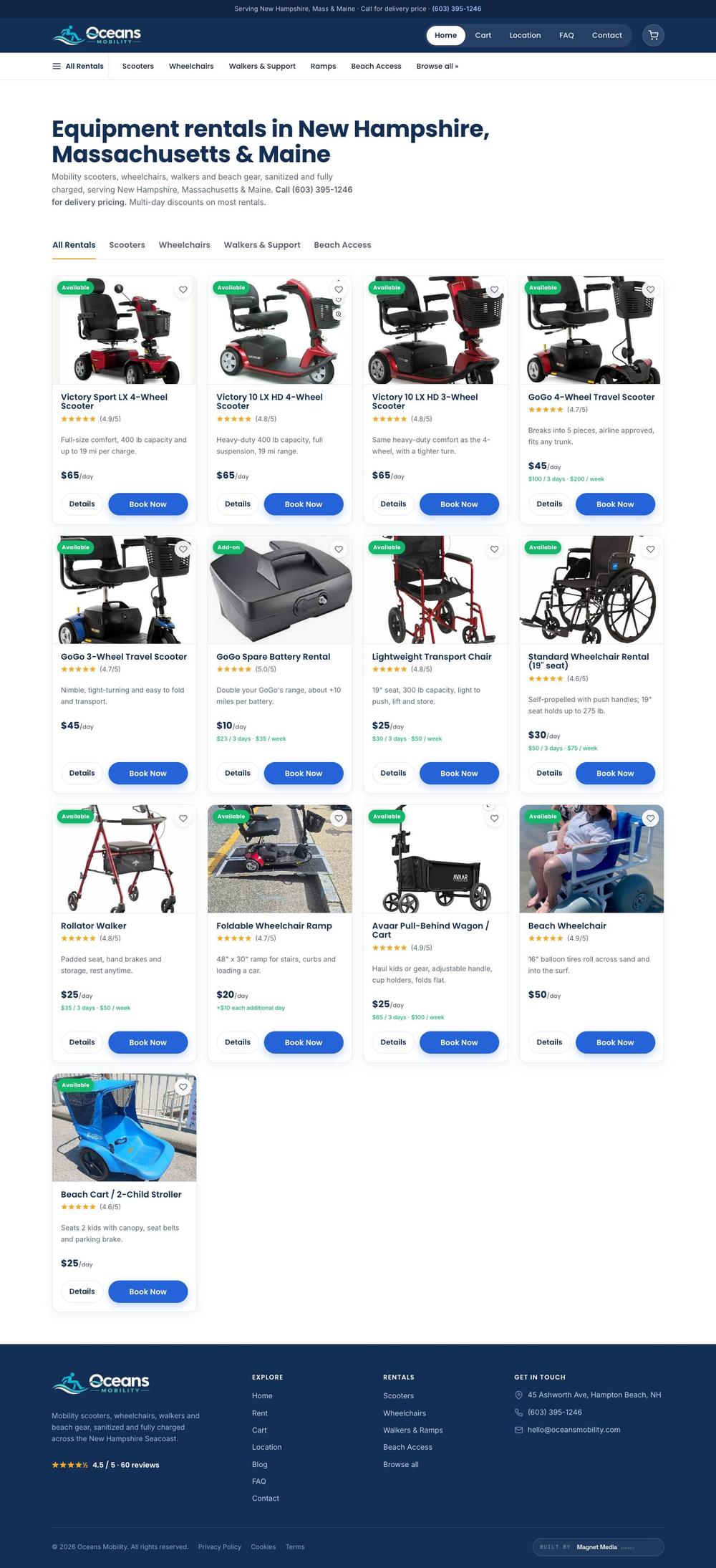
Every piece of equipment got its own listing with clear photos, the key specs people actually ask about, like weight capacity, range and whether it folds into a car boot, and the daily price right there on the card. Filters let people jump straight to scooters, wheelchairs or walkers.
Pick your dates, see your price
Customers choose a start and end date and the site works out the total straight away. Pricing is simple: a daily rate multiplied by the number of days. No surprises, no need to call for a quote.
Secure online payments
We connected a proper payment system so customers can pay by card at checkout. The payment is processed securely and the owner gets the booking details instantly. It turned a ten minute phone call into a two minute checkout.
Built for the people who use it
A lot of the people booking are older, or booking for an older parent. So we kept the text large, the buttons big and the steps few. The whole booking works smoothly on a phone, which is where most people start.
Answers before questions
Delivery areas, how long you can rent for, what happens if your dates change, and how pickup works are all answered on the site. That alone cut down a lot of repeat calls.
The SEO work
A great booking site does not help if nobody finds it. So the second half of the project was getting it in front of people who were already searching.
Pages for the places they serve
The company serves New Hampshire, but people search locally, like "scooter rental Manchester NH" or "wheelchair rental Nashua". We built pages for the towns and areas that matter most to the business, each one written for that place, not copied and pasted with the name swapped.
Pages for each type of equipment
Someone searching for a beach wheelchair is looking for something very different from someone who needs a power chair after a hip replacement. Each type of equipment got its own page that answers the questions those people have.
A steady blog
We set up a regular stream of helpful articles: renting a scooter for a cruise, getting around a city with limited mobility, what to look for in a rental wheelchair, accessible beaches in New Hampshire. These bring in people early in their planning and build trust before they book.
Backlinks that build authority
Google trusts a site more when other trusted sites link to it. We built links from local New Hampshire directories, healthcare and senior care resources, travel and accessibility guides, and local business listings. Every link was relevant to mobility, travel or the area, never cheap bulk links that can hurt a site. As the links came in, rankings for the main rental searches climbed with them.
The technical side
Fast pages, clean structure, proper titles and descriptions, structured data so Google understands the business, and a Google Business Profile that matches the site. None of it is exciting, but all of it adds up.
Results
Within four months of launch, the site ranked on the first page of Google for its main rental searches in its key towns, including scooter rentals and wheelchair rentals in several New Hampshire cities.
Over the following three months, the site earned about 48,000 impressions in Google search and 2,100 clicks, with the number growing month over month as more pages and articles started to rank.
More importantly, most rentals now come through the website. Customers book and pay at any hour, and the owner spends far less time on the phone answering the same questions.
What made the difference
- Showing prices up front. People book faster when they do not have to ask.
- Taking payment online. A booking with a payment is a real booking, not a maybe.
- Designing for the real customer. Big text and simple steps for an older audience.
- Real backlinks. Relevant local and accessibility sites linking in gave Google a reason to trust the site.
- Local pages, written properly. Each town page actually helps someone in that town.
- A blog that keeps going. Every new article is another way in from Google.
What we would add next
Live availability that blocks out dates when a unit is already rented, so two people can never book the same scooter for the same weekend. We would also add simple reminders before a rental ends, and a way for repeat customers to book again in one tap.
What other rental businesses can take from this
If people still have to call you to find out your price or book, you are losing customers to whoever lets them do it online. Put your prices on the site, let people pay, make it easy on a phone, and then do the SEO work so the people searching in your area actually find you.
Week by week
- Week 1
Equipment, pricing, delivery areas and booking rules mapped out with the owner.
- Weeks 1 to 2
Website designed and built with the rental catalogue, date picker and payments.
- Launch
Site live, payments tested end to end, Google Business Profile updated to match.
- Months 1 to 3
Town pages, equipment pages, the first blog articles and backlink building from local and accessibility sites.
- Month 4 onward
First page rankings for the main searches, with impressions and clicks still climbing.
The numbers
| What | Before | After |
|---|---|---|
| Bookings | Phone only | Online, 24/7, with payment |
| Prices on the site | No | Yes, on every listing |
| Google rankings | Brand name only | Page 1 for main rental searches |
| Search impressions | A few hundred a month | 48,000 over three months |
| Search clicks | Under 50 a month | 2,100 over three months |
I used to spend half my day on the phone. Now I wake up to bookings that are already paid for.
Owner, mobility rental company
Questions people ask about this one
Can you build a website that takes bookings and payments?
Yes. This site lets customers pick equipment, choose their dates, see the total and pay by card in one go.
How long did the website take?
Most of our sites go live in one to two weeks. A booking site like this needs a little extra testing on the payment side.
How much does a website cost?
Websites start at $30/month.
Did you build backlinks?
Yes. We earned links from local New Hampshire directories, senior care and accessibility resources and travel guides. Relevant links like these are a big part of why the site reached page one.
How long does SEO take to work?
It varies by area and competition. Here the main searches reached the first page within a few months, and traffic kept growing after that.
Do I need a blog for SEO?
It helps a lot. Helpful articles answer the questions people search before they are ready to buy, and each one is another way for Google to find you.
Can you do this for other rental businesses?
Yes. Equipment, party, tool and vehicle rentals all work the same way: clear listings, dates, prices and online payment.